There’s no beating around the bush, paid social media is getting harder for charities.
The news cycle doesn’t stop. From global conflicts to the climate crisis and the rise of the far right, organisations are responding to more urgent moments than ever, often at the same time.
Not only that, but advertising costs are rising, tracking is becoming more limited with fewer people opting-in for cookies, and audiences are more sceptical about what they see online thanks to AI. Not to mention team capacity crunches.
But there is hope! Your supporters are spending more time than ever on social media, and you can still reach them, if you know how to use the channels well.
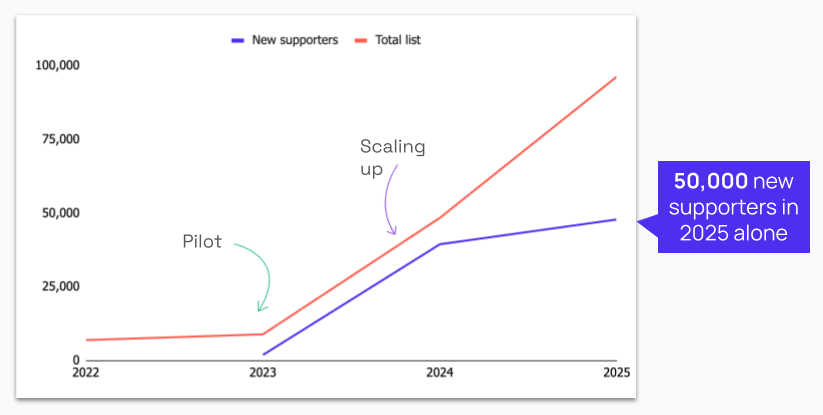
Since 2022, we’ve been working with Action Against Hunger to build an always-on paid social media programme that has successfully:
- Grown digital income 3.4x in two years (and rising)
- Generated the majority of the digital programme’s £1m in lifetime value
- Recruited 85,000 new supporters to their email list in 4 years
So what’s behind that growth?
Here’s what Jimmy (Senior Digital Manager at AAH) and Beth Miles (Partner Strategy Lead at Forward Action) have to say about the partnership, and what you can learn from it.
1. Smarter, faster creative development
A key shift in AAH’s programme was moving away from slow, highly produced creative towards testing lots of ideas, quickly.
“We basically looked at creating lots of different types of creative very quickly, to test”
Jimmy Perkins, Action Against Hunger
Instead of investing heavily in a small number of assets, the team focus on volume – producing a wide range of lo-fi creative to see what resonated with people.
This makes it easier to respond to live moments, try new ideas quickly, and get creative in front of audiences without long production timelines.
To drive results, your paid social media creative must:
- Cut through
- Feel native to the platform
- Give a clear reason to act
Too often charity fundraising falls flat on social because it sticks to traditional charity imagery and messaging, which misses that brief.
We needed to test creative that stood out! That included:
- Urgent, news-style graphics
- Handwritten or human-feeling visuals
- Minimal, “undesigned” formats
- Simple video shot and edited quickly
- Map imagery that turned abstract crises into something immediate and actionable, as well as educating readers
- Images of ‘villains’ e.g. using images of Keir Starmer when talking about government policy is some of the most engaging creative AAH has ever run
- Bold, repeated graphics to hammer home a message – e.g. a stat, statement or a call to action
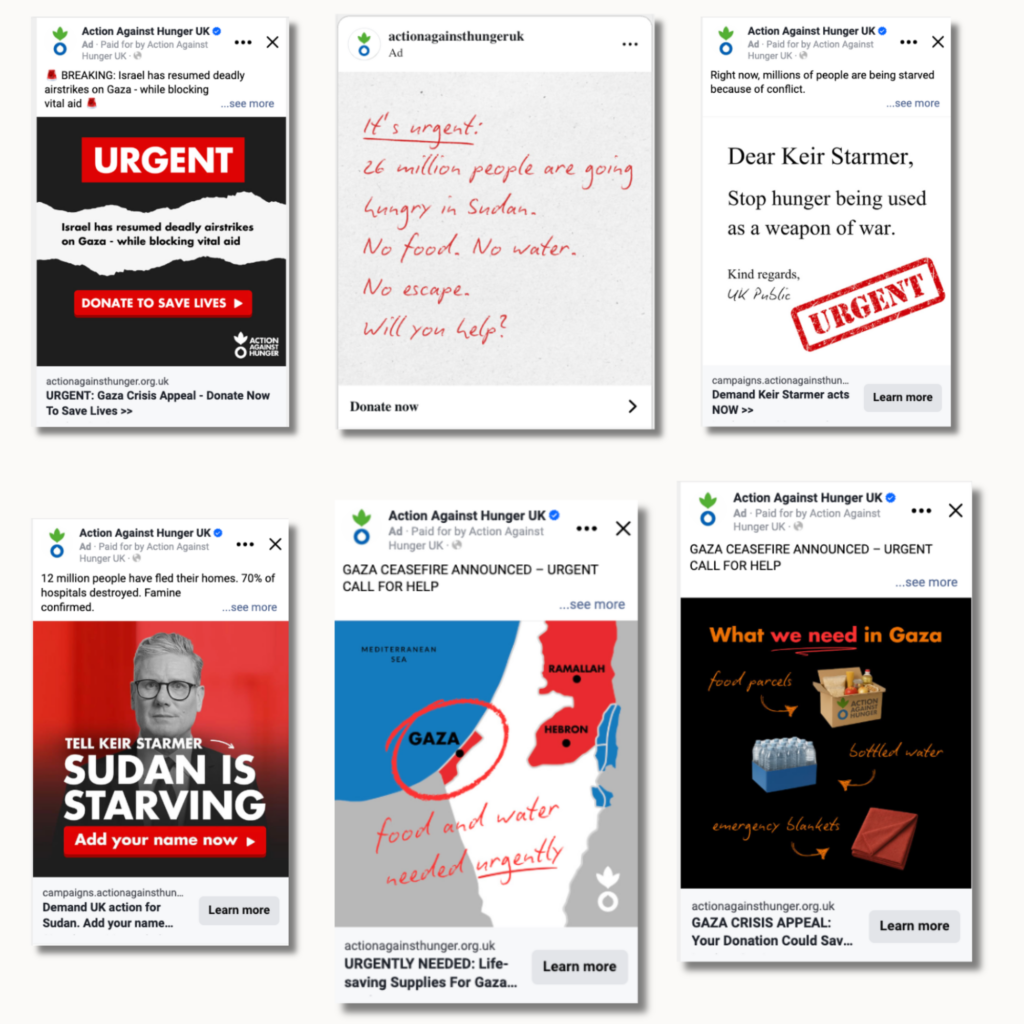
The results are clear. Creative that feels more immediate and native to the platform consistently drives stronger engagement:
- Urgency-led ads delivered 2x higher click-through rates compared to the 2025 average
- Human-style creative achieved 11% cheaper CPMs
- Ads featuring political decision-makers reached 6.5% CTR vs a 2% benchmark
“We’ve seen more human creative really drive results — using things like handwriting fonts that make it feel like a real person has written it. We’ve seen this work really well.”
Beth Miles, Forward Action
Timing also plays an important role. With so many competing appeals, campaigns perform best when there’s a clear and relevant “why now” — even better if it ties in with something already capturing public attention.
Try today:
- Test more ideas, not just better-designed ones
- Prioritise speed over polish – don’t let your brand hold you back
- Focus on formats that feel at home in the feed, e.g. ‘real’ videos
- Time it wisely – react quickly to public moments that relate to your topic area
2. Test, test, and test some more!
Creative is only part of it. A key part of the approach is how quickly the team can learn and act on what they are seeing.
“Testing isn’t about figuring out what works and then sticking to it. It’s a work in progress — it’s about getting the best results right now.”
— Beth Miles, Forward Action
Rather than treating campaigns as fixed at launch, the team approaches them as something that is continuously evolving, adjusting creative, spend and focus based on what the data shows.
Testing is built into the workflow:
- Multiple creative concepts launched at once
- Performance reviewed regularly
- Budget actively shifted based on results
What works in one campaign won’t always work in another.
For example:
- Creative that performed strongly in one appeal performed worst in another
- Different channels delivered different strengths:
- Google Ads: highest Return On Ad Spend (ROAS) (353%) but lower volume
- Meta: highest volume of donations
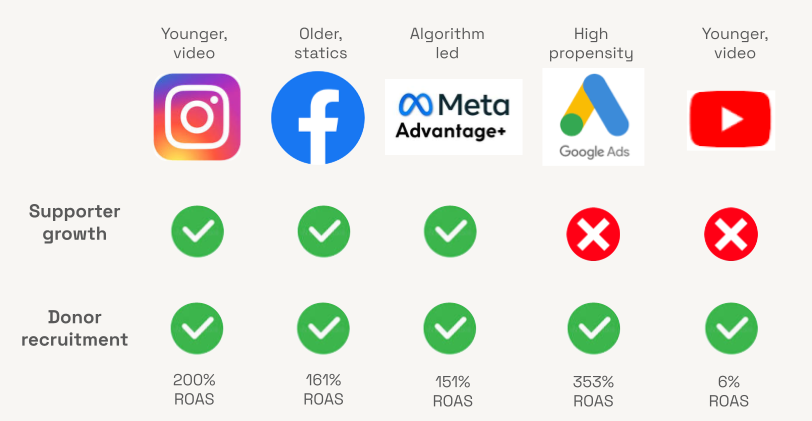
Direct-to-donate campaigns typically deliver returns between 0.4 and 1.0, while restricted campaigns can reach as high as 2.8 ROAS for standout appeals.
Decisions are made quickly, usually within one to two weeks of launching tests, allowing the team to scale what’s working and switch off what isn’t without delay.
“Making sure we got learnings and insights very quickly on what does and doesn’t work… allowed us to either put more budget behind certain assets, or turn off things.”
— Jimmy Perkins, Action Against Hunger
There isn’t a single “best” approach, performance will always depend on context, timing, and audience.
Top testing tips:
- Build testing into how you work, not just how you launch
- Make decisions quickly, scale what’s working, cut what isn’t
- Expect results to vary between campaigns
- Make sure you’ve got a good reporting set up, with clear templates for tracking the metrics that actually matter for your goals
- Have your ads manager set up clearly so it’s easy to understand what’s happening
3. Introducing new ways of working
To move at the pace required, Action Against Hunger changed how they worked internally:
- They created a cross-departmental digital mobilisation working group, meeting weekly to respond to the news cycle
- They established an open culture and a dedicated Microsoft Teams channel to approve creative and talking points quickly when an emergency hits
“We introduced new ways of working… meaning we could get ads up within a space of hours, or under a day.”
— Jimmy Perkins, Action Against Hunger
This speedy set up means the team can get ads live while issues are still front of mind, test and iterate before performance drops and stay relevant in a fast-moving news cycle.
Setting your team up for success:
- Look closely at how long it takes to get ads live
- Try to reduce bottlenecks in approvals
- Give smaller teams the autonomy to act quickly
4. Turn emergency urgency into long-term value
A lot of Action Against Hunger’s activity is driven by urgent, reactive moments. But whilst immediate raising money is key, there’s value to unlock in what happens after that first action.
— Jimmy Perkins, Action Against Hunger
“We wanted to focus more on the top of the funnel and digital journeys.”
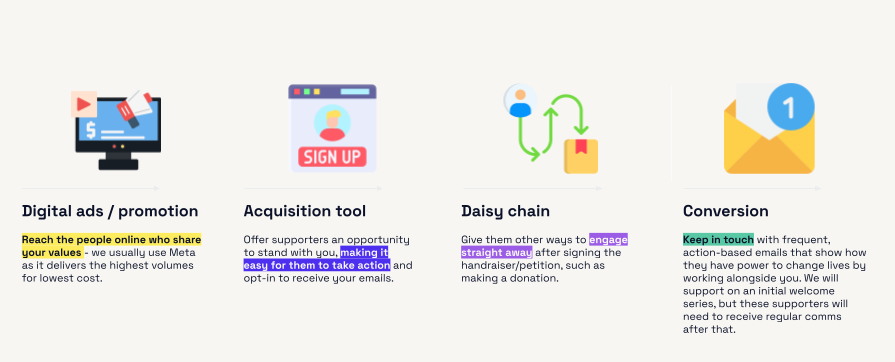
Instead of treating campaigns as one-offs, AAH connects them into a broader system — bringing people in, building engagement, and creating opportunities to take further action over time.
And it’s working. Alongside incredible growth in recent years, the programme hits stable and sustainable acquisition costs (it costs approx £1.80 to recruit a new subscriber, and £41 to acquire a cash donor, since you probably want to know the benchmarks!). Together, we’re creating a strong foundation for long-term value.
- 50,000 new supporters recruited in 2025 alone
- Email list growth of over 14x in four years
- Digital income making up a growing share of total organisational revenue
This approach has also contributed to significant growth in regular giving — growing AAH’s number of regular givers from under 3,000 in 2023 to over 10,000 in 2026 (these givers were recruited through digital channels, including telemarketing to subscribers recruited through online channels).
Most of AAH’s paid social media activity focuses on recruiting one-off donations. Those new supporters are then welcomed with a structured email journey, a five-part series designed to build engagement before making a regular giving ask.
Start building a programme for long-term value:
- Plan for what happens after the first action
- Invest in journeys, not just acquisition
- Monitor longer term metrics like repeat action rates and six-month engagement
So what’s the trick to making paid social media work for you?
Success lies in bringing together fast-moving teams, a culture of testing and learning, and the creative freedom and curiosity to experiment with the latest content trends and news stories. This enables you to tap into your supporters’ lives in a way that inspires action.
Here’s your five point plan to get started:
- Try simple, lo-fi creative
- Test lots of creative, quickly
- Make decisions based on performance
- Reduce friction in how work gets done
- Build journeys that extend beyond a single campaign
We hosted a webinar with Jimmy Perkins and Beth Miles that digs even deeper into the data and tactics included here. If you didn’t make it, you can watch the recording back here.
And if you’re wondering where to start on putting these into action, drop us a line at hello@forwardaction.uk – our Forward Action team would love to help you test your way to success.